Global standards.
Safer workplaces.
The Department of Occupational Safety Programs is a specialty division of International Medical Competency Accreditation Council (IMCAC) — an independent competency assessment and certification body offering competency-based credentials across bloodborne pathogens, infection control, healthcare worker safety, laser safety, and clinical waste management.
Advancing Workplace Health & Safety through independent competency assessment.
We equip healthcare workers, safety officers, and organizations with the evidence-based training they need to protect themselves, their patients, and their communities — with a rigorous competency-based approach whose curricula are aligned to OSHA, CDC, and WHO guidance.
Five pillars of occupational safety.
From our flagship Bloodborne Pathogens certification to specialty programs launching soon.
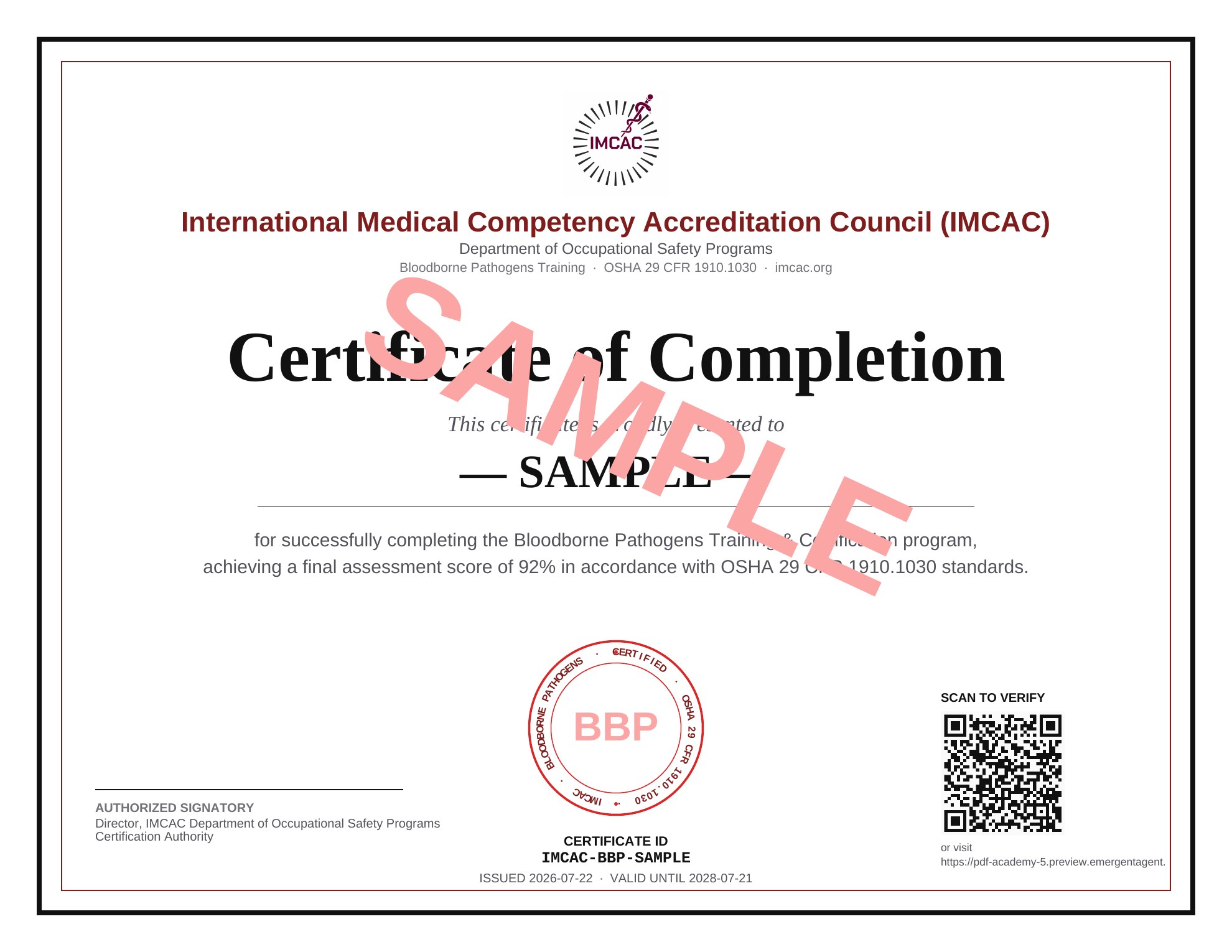
Our flagship program. Complete 13 interactive modules, pass a 50-MCQ exam with an AI-graded case study, and earn an independent competency-based IMCAC certificate valid for 2 years.
A comprehensive program covering hand hygiene, environmental cleaning, sterilization, aseptic technique, and outbreak response for healthcare and long-term care settings.
Protect the caregiver. Covers safe patient handling, needlestick prevention, ergonomics, workplace violence de-escalation, and mental-health first aid for clinical teams.
For clinical teams operating surgical lasers, electrosurgery, and radiofrequency devices. Covers ANSI Z136.3 medical laser safety, plume management, and OR fire prevention.
Comprehensive training on regulated medical waste — segregation at source, labelling, packaging, transport, treatment, and audit trails aligned with EPA/RCRA and WHO guidance.
Bloodborne Pathogens Training & Certification.
OSHA 29 CFR 1910.1030-aligned course with 13 interactive modules, a 50-MCQ exam, and an AI-graded case study tailored to your profession. Complete in 45–60 minutes and receive a verifiable 2-year certificate.

Rigorous. Independent. Practical.
Content aligned to OSHA, CDC, and WHO guidance — competency-based credentials, not regulatory endorsements.
Every program is authored and reviewed by working clinicians, biosafety officers, and safety compliance experts.
Guidelines evolve — so does our content. New research triggers course updates within the certification cycle.
Certify one professional or an entire team.
What our certificate
is — and isn’t.
We’re direct about scope so there are no surprises later. IMCAC is an independent competency assessment and certification body — not an accreditor, licensor, or regulator.